Parking Lot Patching vs. Resurfacing: Don’t Make the Wrong Repair
| Key Takeaways: Parking lot patching repairs isolated potholes and damaged sections, while parking lot resurfacing adds a new asphalt layer across a worn but stable surface. Choose patching for limited damage, resurfacing for widespread wear, and full-depth repair when the pavement base has failed. |
The parking lot patching vs resurfacing decision can save your pavement or make you pay twice for a repair that never had a chance. Patch isolated damage when the surrounding asphalt and base remain sound. Choose parking lot resurfacing when wear covers much of the lot, but the foundation can still support a new asphalt layer.
A pothole, faded surface, or web of cracks only shows part of the problem. Water may be moving through open joints. Heavy trucks may be crushing a weak section of base. An old overlay may also hide movement below the surface. The right repair starts with the cause, not the darkest and smoothest option.
Trinity Asphalt Paving, Inc. is based in West Palm Beach and serves commercial properties, condo associations, HOAs, and residential communities across South Florida.
Our crews install, repair, resurface, seal, and stripe asphalt throughout Palm Beach County and nearby areas.
The Fast Answer
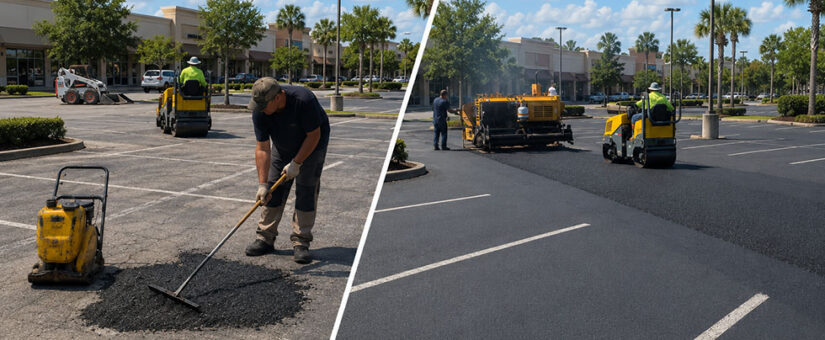
 Patching treats a defined failure. The damaged asphalt is removed or prepared, unstable material is corrected, and new asphalt is compacted into that area. It works well for one pothole, a failed section near a drain, or damage caused by repeated truck traffic.
Resurfacing treats most or all of the driving surface. The lot is cleaned and prepared, failed areas are repaired, a bonding coat is applied, and a continuous layer of hot asphalt is installed. The result is smoother and more uniform, but it only works when the pavement below remains stable.
The Federal Highway Administration classifies pothole repair and the patching of localized pavement deterioration as corrective maintenance. That definition matters because a localized repair solves a defined defect. It does not replace a failing pavement structure. FHWA pavement preservation guidance explains the difference between corrective maintenance, preservation, rehabilitation, and reconstruction.
What Patching Actually Repairs
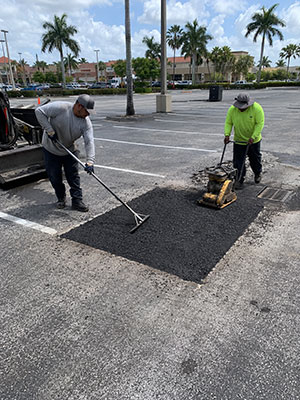 A proper patch should address the failed area, not hide it. For a saw-cut repair, the crew cuts clean edges around the damage, removes broken pavement, corrects weak base material as needed, applies a tack coat, places hot mix asphalt, and compacts the repair.
This approach fits:
- Individual potholes
- Small depressions around drains
- Localized cracking surrounded by solid pavement
- Failed asphalt near dumpster pads or loading areas
- Damage in wheel paths and tight truck-turning zones
Our asphalt patching and pothole repair process includes saw-cut repairs, base preparation, bonding material, compaction, and sealing where the new asphalt meets the existing surface.
 What Resurfacing Changes
 What Resurfacing Changes
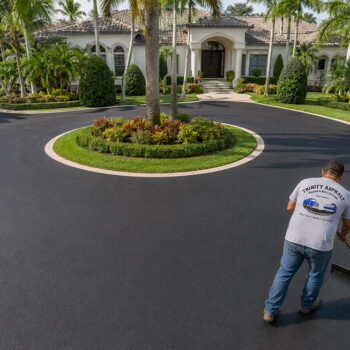
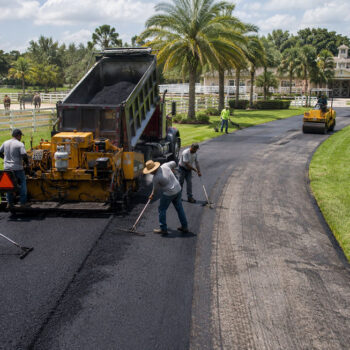
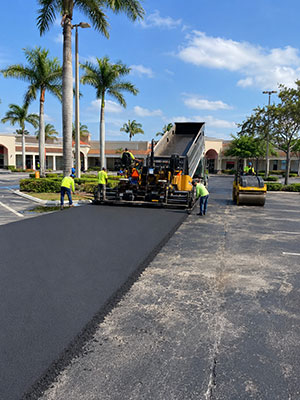
Parking lot resurfacing adds a new asphalt layer across the existing pavement. Preparation may include cleaning, vegetation treatment, saw-cutting high areas and tie-ins, filling low spots, repairing failed sections, and applying a tack coat before paving.
The parking lot paving and maintenance process used by our team includes a compacted 1.5-inch layer of hot asphalt for a typical overlay after preparation and bonding. Project conditions can require a different plan, so thickness, drainage, elevations, curbs, and traffic loads must be reviewed before work begins.
The Asphalt Institute reports an estimated service life of 8 to 14 years for a hot mix overlay selected for stable pavement with a sound base. It also warns that structural defects can quickly reflect through a new surface. Its pavement preservation guide lists cracking, rutting, raveling, roughness, drainage, and traffic among the conditions used to select a treatment.
Patching and Resurfacing Compared
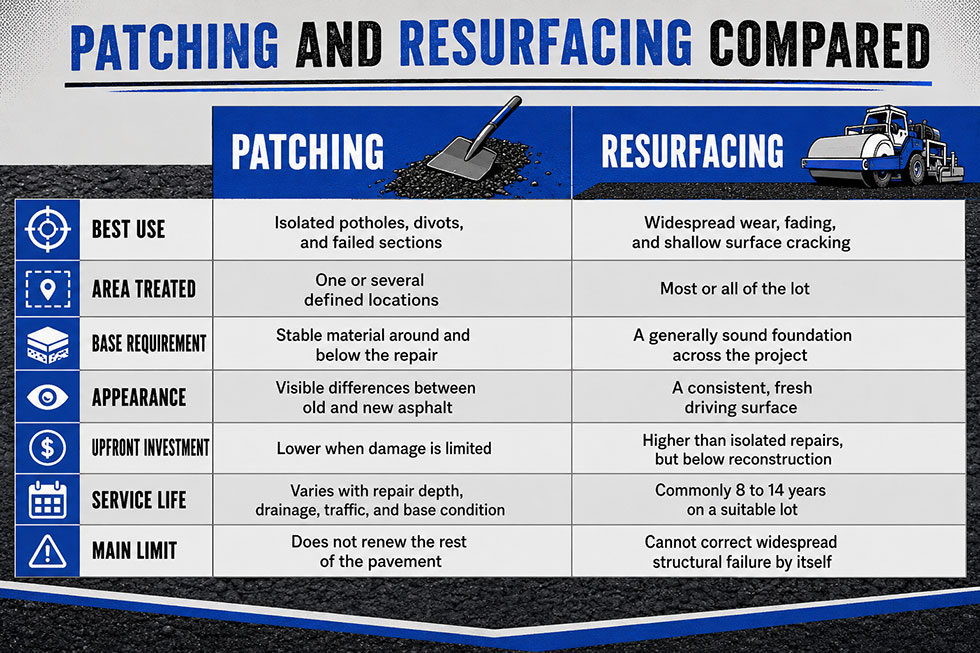
Patching works best for isolated potholes, divots, and failed sections. It treats one or several defined areas while leaving the rest of the pavement untouched. The surrounding asphalt and base must remain stable for the repair to hold.
Resurfacing covers most or all of a worn lot with a fresh asphalt layer. It creates a smoother, more consistent appearance and commonly adds 8 to 14 years of service life when the foundation remains sound.
Patching usually requires a lower initial investment when damage is limited. Resurfacing costs more but renews the broader driving surface. Neither option can correct widespread structural failure without deeper repairs.
When Parking Lot Patching Is the Smarter Repair
Targeted repairs often make sense when less than about 25 percent of the surface shows damage. Treat that figure as a screening point, not a fixed engineering rule. A small damaged area can still require deeper reconstruction if the base is soft, wet, or moving.
A retail lot near Glades Road in Boca Raton may need one failed delivery lane repaired while the remaining pavement stays firm. An office property near Congress Avenue in Delray Beach may have a depression beside a storm inlet caused by a confined drainage problem. In each case, repairing the affected section can stop water intrusion and restore a safer driving surface without covering the full lot.
Patching is also useful when the property needs an urgent repair before a larger project. A deep pothole at an entrance or loading area should not remain open while owners plan a future overlay. Still, repeated failure in the same spot is a warning. The base, drainage, or vehicle loading may be the real problem.
When Parking Lot Resurfacing Makes More Sense
Resurfacing becomes the stronger middle option when the lot is worn across broad areas but still has a dependable base. Common signs include faded and oxidized asphalt, shallow cracking, minor surface irregularities, loose aggregate, and numerous older repairs.
Age can support the decision, but it cannot make the decision by itself. A parking lot between 10 and 20 years old may be a good candidate if the base remains stable. A newer lot with poor drainage or weak construction may need substantial repair sooner.
Consider an overlay when:
- Surface wear appears across most of the property
- Cracks remain shallow and have not developed into widespread base failure
- Previous patches have become numerous but remain stable
- Drainage and elevations can support an overlay
- The owner wants a uniform surface and updated parking lot striping
A condo community west of Federal Highway in Boca Raton may use resurfacing to renew long drive aisles and parking courts. A shopping center near Atlantic Avenue in Delray Beach may phase the work to keep storefronts and service lanes accessible.
When Neither Option Goes Far Enough
A new surface cannot repair a foundation that is breaking apart. Widespread alligator cracking, deep rutting, pavement movement, pumping water, recurring potholes, and large sunken areas often point to failure below the top layer.
These conditions may call for full-depth repairs, removal of failed pavement, base replacement, drainage corrections, or reconstruction. Resurfacing before that work can create a good-looking surface that cracks again as the unstable pavement moves below it.
Our asphalt repair and resurfacing services cover localized repairs, overlays, new installations, crack treatment, seal coating, surface leveling, and other work selected for the actual condition of the pavement.
South Florida Weather Changes the Repair Plan
South Florida asphalt faces strong sunlight, high surface temperatures, heavy rain, tropical weather, and long periods of moisture. Sunlight and heat dry the binder and leave the surface gray and brittle. Open cracks then give rain a path into the pavement and base.
Drainage deserves close attention on commercial properties along Okeechobee Boulevard in West Palm Beach. Flat sites in Royal Palm Beach can hold water if drains, slopes, or low areas stop working as planned. Loxahatchee and Wellington properties may also carry horse trailers, equipment, delivery vehicles, and heavy trucks that place concentrated loads on turning lanes and entrances.
Local conditions can change the scope. A shallow depression may need leveling. A wet base may need removal and replacement. A transition near a sidewalk, curb, or storm drain may need saw cutting so the finished surface meets the correct elevation.
How We Decide Which Repair Fits
A dependable recommendation comes from inspecting the full lot, not one close-up photo. Our evaluation looks at:
- The location and percentage of visible damage
- Crack patterns, potholes, ruts, and depressions
- Standing water and signs of drainage trouble
- Movement or softness under vehicle loads
- The condition of previous repairs
- Traffic volume, truck routes, and turning areas
- Curbs, drains, sidewalks, entrances, and tie-ins
- Access needs for customers, residents, deliveries, and emergency vehicles
For HOAs and property managers, staging matters almost as much as the repair. Our condo and HOA asphalt projects include a Palm Beach County resurfacing project covering more than 300,000 square feet. Large properties can often be divided into phases so residents and businesses retain practical access during the work.
Local Experience Matters Before the First Truck Arrives
Our family-owned company has three generations of paving experience and is licensed and insured. Trinity Asphalt Paving works across Palm Beach, Broward, and Miami-Dade counties, with regular service from Loxahatchee and Wellington to West Palm Beach, Delray Beach, and surrounding communities.
That local experience helps us account for stormwater, flat grades, intense sun, heavy seasonal rain, and the traffic patterns common to South Florida properties. It also helps us explain when a smaller repair is enough and when a broader project will provide better long-term value.
Choose the Repair That Solves the Real Problem
Patch isolated failures when the nearby pavement and base remain dependable. Resurface broad surface wear when the foundation can support a new layer. Rebuild failed areas when water, traffic, or weak base material has damaged the pavement structure.
Do not choose from appearance alone. A site inspection can show how far the damage extends and what caused it. Contact Trinity Asphalt Paving for a responsive assessment of your parking lot in Loxahatchee, Royal Palm Beach, Wellington, or nearby South Florida communities.
Click here or give us a call for a free, no-obligation quote.
Trinity Asphalt Paving, Inc.
📍 6643 Royal Palm Beach Blvd. West Palm Beach, FL 33412
📞 Call 561-889-2615
- Posted by Trinity Asphalt Paving
- On July 17, 2026
- 0 Comment